Oilton
The Legend of William OhOilton is a Third-Floor Stronghold built around an oil industry and associated with the Wyrd family. It first appears as a distant industrial settlement promising wealth and shelter, then becomes the site of a carefully prepared sabotage that escalates into the destruction of the entire city. Its importance lies in that transformation: Oilton is not merely a destination on the route upward, but a compact demonstration of how infrastructure can concentrate power, sustain civilization, and turn a local failure into a city-wide inferno.
Setting and Industrial Identity
Oilton stands beyond a Key Site, a couple of days’ travel to the north, and is visible only as a smudge on the horizon because the Third Floor’s optics make distant objects difficult to distinguish. Travis presents it as his family’s Stronghold, a city organized around a giant corkscrew that pumps oil directly from the ground through steam power. The description gives Oilton a distinct material identity: its prosperity depends on an engineered mechanism rather than on ordinary agriculture or trade alone.
The city’s industrial system also depends on magical resources. When Will asks where Oilton obtains water, Travis explains that the city relies mostly on Abilities that create water, with the Third Floor rewarding such powers particularly well. The Wyrd family is especially prominent in that economy. Oil production and water creation therefore form complementary foundations of settlement, showing how the Stronghold converts specialized powers into public infrastructure and commercial wealth.
Oilton’s name is deliberately plain, and Mark Wyrd regards the place with mixed disappointment when he approaches it as his first Lordship. He had imagined claiming hostile wilderness on the Eleventh Floor or ruling a gleaming city on the Fifth Floor; instead, he finds himself facing a modest oil city on the Third Floor. The contrast between his grand expectations and Oilton’s practical scale emphasizes that lordship can begin in an unglamorous industrial outpost rather than in a spectacular frontier.
A Fortified Threshold
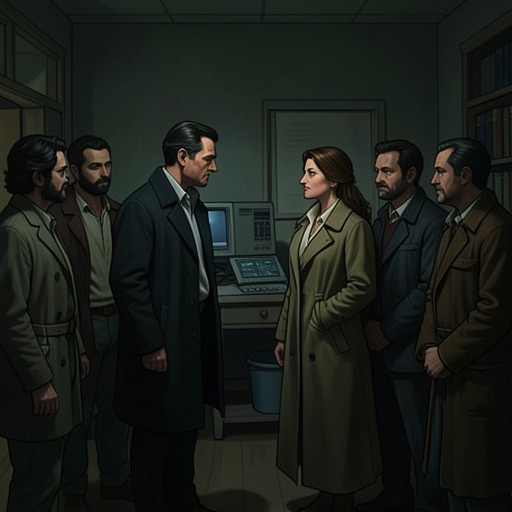
The party approaches Oilton under the changing darkness of the Third Floor. At night, the Stronghold contracts visually into small pools of light around the city’s edge, maintained by man-sized beacons burning on the walls. One nearby section of wall is partly shadowed at its base, while the top remains illuminated, creating a narrow route by which an enterprising climber could begin an ascent without being seen.
This arrangement makes Oilton both a settlement and a controlled threshold. Its walls, beacons, darkness, and concealed approach turn entry into a problem of observation and timing. The city’s defenses are not presented as abstract fortification; they shape what bodies can do, where they can move, and who can cross from the surrounding landscape into the Stronghold. The industrial city is thus also a tactical space, one whose security depends on the management of light, height, and access.
Oilton’s position within the larger climbing system is equally important. Once Climbers reach level 5, experience gain in the Hunting Grounds and on the 1st Floor is reduced, making ascent to the 2nd Floor necessary for further growth. Established routes offer a slow, safe, and reliable path, while clearing a Key Site opens a quicker but more dangerous inter-floor Door. Oilton belongs to this broader geography of advancement: settlements and Key Sites are not isolated locations but links in a system where movement, experience, danger, and infrastructure determine who can continue upward.
The City Before the Collapse
Oilton is approached as a functioning center with enough economic importance to attract powerful claimants. Travis states that his older siblings may arrive within weeks to reclaim it because the city can sell crude oil to other floors and generate millions of gold each month. That expected revenue explains why Oilton matters to the Wyrd family beyond sentiment or prestige. It is a critical piece of infrastructure, and ownership of it carries both political and financial consequences.
The city’s wealth also creates a strategic dilemma. Will suggests that destroying everything should be treated as plan B, while the group considers what to do with the Stronghold. The choice is not simply between occupying a town and abandoning it. Oilton represents a functioning resource network that could be exploited, defended, or denied to an approaching family. Its value makes preservation attractive, but its machinery also supplies the means by which sabotage can produce disproportionate damage.
The danger surrounding Oilton is not limited to human succession. Loth calculates that thirteen thousand Tangled are stalking the city, up from just below nine thousand three days earlier, with the population increasing by 14.28 percent per day according to data supplied by the Jibleya. The city is therefore under pressure from a rapidly reproducing threat whose growth is not linear in practical effect. Oilton’s industrial infrastructure must be understood alongside an expanding ecological and military crisis, making delay increasingly costly.
Destruction of Oilton
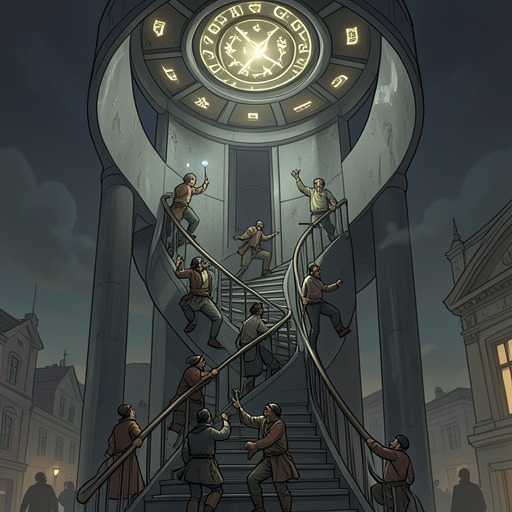
The destruction begins as an engineered chain reaction rather than a conventional assault. Will and Loth discuss Build strategy while a trap works on the city’s systems; a blinking light on top of the water tower signals that the mechanism has caught someone, and the steam engines begin to produce more pressure. The pressure rises gradually in the oil lines, turning an apparently limited intervention into a mounting industrial hazard.
About half an hour later, Oilton explodes. The castle is the first major point of failure, erupting with burning oil when the over-pressured main line ruptures directly beneath it. The castle shatters, throwing flaming boulders in every direction, while a fireball rises into the sky and dwarfs the mountain on which Will and Loth are watching. Even at that distance, Will can feel the heat, making the city’s destruction physically present beyond the immediate blast.
The first rupture then becomes a cascade. Flaming boulders fall into the streets, rupture additional oil lines, and spread burning oil through the city. Smoke and fire engulf Oilton until the Stronghold resembles a nightmare rather than a defensible settlement. The scale of the outcome surprises Will, who had not expected Loth’s single trap to destroy the entire city. Loth’s sabotage converts Oilton’s own infrastructure into a weapon against itself: the system that pumps and distributes wealth becomes the mechanism of annihilation.
Aftermath and Significance
Oilton’s destruction changes the practical situation for everyone connected to it. Loth reaches the level cap for the Third Floor after blowing up the city, but her success comes with severe bodily consequences: she must regrow scales, experiences hypersensitivity and pain when moving, and uses a rental wheelchair during recovery. The group replaces tools lost during the flight from Oilton and shops for a larger barrel for Loth, whose greater Strength allows her to divide its interior into several biomes. The city’s destruction therefore continues to shape ordinary logistical decisions long after the fire itself has ended.
Will uses the experience gained while fighting bandits to reach level 10 in Oilton, unlocking a Secondary Ability and another Primary Ability upgrade slot. His reflection on whether to choose a direct-damage Ability shows the Stronghold functioning as a turning point in his development even after its physical disappearance. He recognizes the effectiveness of Loth’s attack but also understands that it belongs to her intended Build and should not be copied casually. Oilton becomes an occasion for strategic judgment as well as advancement.
The city’s disappearance creates uncertainty for those who depended on its routes and services. Steve, who had been earning money by healing Parties traveling through Coalton, hears rumors that buses are being attacked and that Oilton has gone silent. He worries that Will may have died somewhere on the Third Floor, revealing how quickly the destruction of one Stronghold disrupts information, travel, and livelihoods far beyond its walls. When Travis is later found alive but pale, bruised, and exhausted after escaping, he can offer only fragments of his survival strategy, including a speed boost based on the number of enemies.
Oilton ultimately stands as a paradox of concentrated civilization. Its oil pump, steam pressure, water economy, walls, beacons, family ownership, and lucrative trade make it a symbol of organized power; the same concentration allows a trap to pass through one vulnerable system and destroy the whole city. The Stronghold’s narrative function is therefore structural as much as geographical. It joins the book’s recurring concern with dangerous thresholds and unstable systems, showing that progress through The Tower depends not only on climbing higher but also on understanding how routes, resources, bodies, and machines can fail together.